The Risks and Rules of Documenting ICE Activity: A Complete Guide
In January 2026, two Americans were killed simply for observing Immigration and Customs Enforcement (ICE) operations in Minneapolis. Renee Nicole Good served as a credentialed legal observer, while her wife recorded the federal agents they had confronted. Alex Pretti held up his phone to capture the agents’ actions—minutes later, that act of documentation would cost him his life. Though even peaceful observation turned deadly for these victims of federal border and immigration enforcement violence, the video footage captured by Pretti and other onlookers is what proved their killings occurred and is now holding the responsible agents accountable. This is the paradox U.S. residents navigate when they choose to resist and record ICE’s growing incursion into cities and communities across the country.
“Unfortunately, there is no way to film ICE completely safely right now—everyone who documents operations takes on risk, because ICE’s conduct has become so aggressive, brazen, and outright illegal,” says Trevor Timm, cofounder and executive director of the Freedom of the Press Foundation. (Disclosure: WIRED’s global editorial director sits on the Freedom of the Press Foundation’s board.) “Alex Pretti was killed in large part because he was filming ICE, which is an absolute travesty. But we got footage of that shooting from half a dozen different angles because other people on scene were also recording. And because of that footage, we immediately caught the Trump administration spreading blatant lies about the incident.”
This tension between risk and necessity has persisted for more than two decades globally, as widespread smartphone access turned video documentation and livestreaming into a cornerstone tool for activists and concerned citizens working to expose injustice and shape public political discourse. In the U.S., people holding cameras or smartphones to record are increasingly targeted by federal agents—despite the First Amendment explicitly protecting the right to record government officials working in public spaces.
The Trump administration has worked hard to obscure this clear constitutional right as immigration enforcement operations have escalated nationwide. In July, Department of Homeland Security (DHS) Secretary Kristi Noem labeled documenting federal agents “violence,” claiming: “It is doxing them. It is videotaping them where they’re at.”
DHS spokesperson Tricia McLaughlin echoed that framing in a statement to WIRED, saying that “videoing our officers in an effort to dox them and reveal their identities that is a federal crime and a felony.” DHS has held firm to this position—even though, by DHS’s own questionable definition of doxing, ICE agents effectively “dox” themselves by working in public view.
That kind of rhetoric puts every person recording ICE agents—whether they are legal observers, activists, or reporters—at direct risk, says Jackie Zammuto, associate director at Witness, a nonprofit dedicated to using video to fight human rights violations.
“Video documentation has the power to expose abuses, to help call for accountability, and to challenge official narratives,” Zammuto says. “At the same time, we’re absolutely seeing an increase of documenters being targeted—including journalists who are clearly marked as journalists—even when they’re doing it legally, even when they’re respecting orders from the police. It is a massive risk, and I think that it's important for people to weigh that risk and their own comfort in taking it.”
Yet Zammuto also notes there are practical steps to reduce your risk when recording authority figures like ICE agents. “There are ways to be safer, to consider your own security and also the security of those around you,” Zammuto says. Below are key safety and best practice tips WIRED compiled from interviews with activists, legal experts, media professionals, and investigators who have long used video documentation to hold power accountable.
Before Filming
When planning to record ICE or Customs and Border Protection agents, or document activity at a protest, using an alternative or burner phone can help protect your privacy and the privacy of everyone around you. Even so, leaving no digital trace at all is nearly impossible today: immigration officials have built massive surveillance capabilities, including purchasing private online advertising data, deploying surveillance drones, tapping into national license plate reader networks, and accessing systems that can track mobile devices across entire neighborhoods.
Beyond broad systemic surveillance, if you are detained on scene or at a later date, ICE or Border Patrol can seize your device and extract all your personal data, creating direct surveillance risks. If you do bring your personal daily device to an event, turn off all biometric unlocking, disable Face ID and fingerprint access, and use only a password or PIN to secure your device. Officials are required to have a warrant or court order to compel you to share a PIN or passcode, while it is legally far easier for them to force you to unlock your device via biometrics.
Even with that precaution, you may still face pressure to unlock your device for agents no matter how it is secured. Using a separate device that does not store your full personal digital life minimizes how much data can be exposed in a worst-case scenario.
While Filming
As soon as you are near an active incident, start recording, and keep your camera rolling for as long as you are on scene. Film horizontally rather than vertically to capture more of the full context of the scene. “We think it's really important to try to capture as much of the situation as possible continuously. If you start and stop your footage, it's easier for people to say it's been manipulated or things have been cut out,” Witness’ Zammuto says.
With cheap, easy-to-use AI video generation tools available to nearly anyone today, bad faith actors can easily create fake footage of ICE activity to discredit authentic documentation. Filming a slow 360-degree pan of the full surrounding area proves the context of the scene and makes it much harder to claim your footage is not authentic. The New York Civil Liberties Union (NYCLU), for example, recommends making your footage easier to authenticate by also capturing wider context—including nearby landmarks or street signs—as well as filming your phone’s home screen or a clock to clearly record the time and date.
The NYCLU also recommends focusing on ICE agents themselves where possible to document their activity, rather than tracking the people impacted by the agents’ actions. Keeping the lens trained on agents makes it more likely you will capture visible badge numbers, officer uniform details, vehicle license plates, or other identifying details to advance transparency and accountability. Additionally, keep recording for as long as possible, even after interactions with agents appear to end, to capture any unexpected activity that unfolds as crowds disperse.
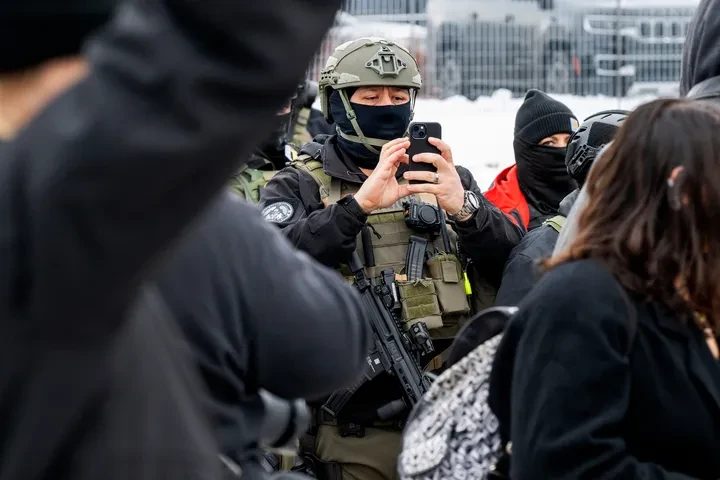
Intimidation of people filming is a common tactic on scene. For example, independent journalist Ken Klippenstein once shared a video showing what appears to be an ICE agent scanning a legal observer’s car. When the observer asked why the agent was scrutinizing their vehicle, the agent responded: “We have a nice little database, and now you’re considered a domestic terrorist. So have fun with that.”
When interacting with federal agents while filming, experts agree it is important to show clear compliance to de-escalate tension. The goal of documenting ICE is to create accountability, not to intervene in their operation. When possible, it can help to capture yourself on camera interacting peacefully with agents and complying with their orders.
“If they're saying to step back, step back, so that they don’t say that you’re interfering,” Zammuto says. “You can say, ‘I am exercising my First Amendment right to observe and document this interaction, and I'm complying with orders,’ and it can be helpful to document yourself complying with those orders. So film yourself taking some steps back and saying ‘I'm backing up.’”
If you need to go further to de-escalate, experts say you should stop filming and do whatever it takes to protect your safety. Given the high-risk current climate, they do not advise secret recording or attempting to trick agents.
“You could be putting yourself more at risk by potentially lying to a federal law enforcement officer or potentially getting yourself into trouble in different ways,” Timm of the Freedom of the Press Foundation says. “I think the best defense against an ICE officer potentially seizing your camera in a public space is other people recording that action and then being able to use that footage as evidence in court when you sue them for violating your constitutional rights.”
After Filming
While it may be tempting (and often newsworthy) to immediately post your footage of ICE activity to social media once you are safe, experts recommend pausing before publishing. “It can expose people in the video to harm as well as the person who filmed it,” says Zammuto from Witness. This includes exposing bystanders’ likenesses to the FBI’s facial recognition systems, which regularly scan social media protest content for matches.
Before sharing, you should consider who appears in your footage, what risks they face if you publish, what repercussions you may face, and what alternative channels exist to share the footage. Precautionary steps, depending on the situation, include blurring the faces of bystanders, scrubbing metadata from files, and removing embedded location data.
Instead of posting footage from your personal accounts, you can share directly with media outlets, investigators, lawyers, people impacted by the operation, or civil society groups. Always create multiple backups of the original footage, such as sharing copies with trusted contacts or uploading to secure cloud storage. Zammuto says you should never edit the original footage or change file names; if edits are needed for sharing, they should be done on a duplicate copy so the original unaltered file is preserved.
“While it is important to share content on social media, these platforms modify content by reducing resolution and quality and stripping informative metadata,” says Hany Farid, a professor at the University of California and leading digital forensics expert. “As such, I advocate always saving the original recordings that can be shared with reporters and forensic analysts like me.”
Uploading files to cloud storage systems like Dropbox or Google Drive is a convenient option, Farid says. One key limitation of centralized cloud storage, though, is that law enforcement can subpoena the service to gain access to your files. DHS has issued at least one subpoena seeking information on people who document ICE activity.
Beyond sharing on social media, multiple formal efforts across the U.S. gather and archive video of immigration enforcement activity. Multiple state attorneys and local governments have set up secure online portals where videos or other imagery can be uploaded to aid future investigations. Attorneys general and officials in New York, Arizona, California, Colorado, Maine, Oregon, Illinois, and Minnesota have all published public complaint forms where people can share incident details to help track federal agents’ actions.
Media organizations, civil society groups, and local community projects also work to gather and document information about ICE activities. Local city “ICE watch” groups and tiplines often maintain shared online drives where photos and videos can be directly uploaded.
While many efforts backup videos, the greatest long-term value comes from systematically geolocating footage, adding clear metadata, and organizing it into searchable databases. Collecting as many videos as possible and verifying their details can be incredibly useful for long-term investigations, says Eliot Higgins, founder of investigative journalism outlet Bellingcat. “You can see patterns of behavior, look at incidents that wouldn’t normally break through on social media, because they aren’t as violent or lethal as some of the other ones, but still show stuff that is at best dubious and possibly illegal or violations of human rights,” Higgins says.
Bellingcat, which has published detailed visual investigations of the two Minneapolis ICE killings and weapons used by immigration agents, is using open source software Atlos to archive and build searchable databases of ICE-related footage for future investigation. “Getting training and those methodologies out there, and having people organize before it happens is very important,” Higgins says, adding that many video classification and archiving techniques have already been refined for other contexts. “There’s a lot of this work that's already been done in the context of Syria and Ukraine, which applies directly to what's happening in the US,” Higgins says.
Using Footage for Legal Accountability
In addition to sharing footage with media organizations and community projects, some people choose to share their footage with attorneys representing people targeted by ICE. ACLU state branches, including ACLU-MN and ACLU-IL, are currently representing legal observers in multiple lawsuits against the federal government.
In these cases, attorneys rely heavily on declarations: signed, sworn statements submitted to court that verify the truth of what a witness saw. Ian Bratlie, an ACLU-MN attorney representing observers in a lawsuit against the federal government, says that because judges need to rely on the court record to establish facts, “declarations are a good way for the courts to hear what is happening on the ground.”
Groups like ACLU-MN have public intake forms where people can submit accounts of suspected unlawful conduct by federal agents. Bratlie says it’s important to be as thorough as possible when submitting, and the more detail the better.
“Everybody’s a little different,” says Bratlie. “Some people are really good about remembering what cars look like, other people are pretty good at remembering actual quotes versus the essence of what was said.”
ACLU-MN processes intake forms, and sometimes follows up with witnesses to prepare a formal declaration to submit to the courts. Bratlie says, “I tend to think video is very helpful, but even people without video should still reach out and talk to us–you don’t need video to prove these are violations.” But video makes testimony far harder to dispute, and catalogs details more comprehensively than fallible human memory.
While lawyers can also rely on news articles to establish facts, declarations are often seen as stronger evidence because there are legal consequences for perjury if a declarant lies under oath. ACLU-MN has used declarations in two lawsuits against Kristi Noem in her capacity as DHS secretary, and the state of Minnesota has resubmitted some of those declarations as evidence in its own lawsuit against Noem.
All of these efforts to hold officials accountable show how powerful visual evidence can be when it’s recorded carefully and ends up in the right hands. “Unquestionably, video has the power to expose the tactics that ICE and authorities are using against people and to challenge the ‘official’ narrative,” Witness’ Zammuto says. “I think that's probably one of the most powerful roles we’re seeing video play: The administration is saying one thing and a video shows something completely different.”
As powerful as documenting ICE activity can be, remember one core rule: There is no way to film federal agents without some level of risk, so think carefully before you choose to document operations. And always prioritize your personal safety.