How a Rural Chinese County Became the World’s Unlikely Crystal Capital
In the Big Purple Crystal storage facility in Donghai County, eastern China, hundreds of imported amethyst geodes stand stacked in neat rows. Their jagged, crystalline interiors are split wide open, like a mouth caught mid-yell. Some are egg-shaped, displayed on hand-carved wooden bases. One large crystal even sits mounted on the back of a bixi — the legendary Chinese beast with a dragon’s head and a turtle’s body. Countless smaller geodes, roughly the size of a human fist, fill shelves and line the floor in cardboard boxes, the same style you’d spot at any New Age gift shop. The owner, Liu Junwen, sits in flip-flops behind his desk, which, fittingly, is carved from an enormous amethyst geode and topped with a sheet of glass.
Mineral deposits are nothing out of the ordinary for Donghai. Liu may not even rank among the largest crystal dealers on his street. Over the last 30 years, this quiet county has transformed from an unassuming rural backwater into China’s unrivaled “crystal capital” — and quite possibly the world’s too. In 2023, the total value of Donghai’s crystal trade was estimated at more than $5.5 billion. Liu is one of roughly 300,000 local people — a quarter of Donghai’s entire population — who work directly in the industry, holding roles from dealers and wholesale suppliers to livestreamers, gemologists, crystal cutters, factory managers, bead stringers, exporters and freight forwarders. Together, they power a global supply chain: the tall Brazilian amethyst display in a London yoga studio, the Colombian quartz on the front desk of a Miami Botox clinic, the Zambian citrine in an overpriced Tulum tourist shop. Odds are, most of these pieces passed through Donghai at some point.
Liu is the first to say that this success was anything but predictable. “I grew up in a village where almost every family lived in poverty,” he says. “It still feels unbelievable that crystals could lift people out of poverty and build wealth.” But stories like Liu’s are commonplace in Donghai. Nearly everyone we spoke to — from taxi drivers and young startup founders to livestreamers and long-time traders — described Donghai as a place defined by sudden booms followed by equally sudden busts. Information spreads at lightning speed, but profit margins can vanish just as quickly overnight. People are always rushing to buy and sell the latest trendy crystal, only to often find the market has already shifted, and someone else caught the wave first.
Western lawmakers and analysts have long argued that China grew into the world’s factory by exploiting low-cost labor and manipulating global markets. But Donghai tells a different story: it shows how much of China’s industrial rise grew out of rural villages, at a time when hundreds of millions of people were desperate to escape poverty and saw global capitalism as their path out. The county became a global crystal hub not primarily because of top-down government industrial policy, but because of an almost all-encompassing drive to hustle and build wealth.
Tectonic Shift
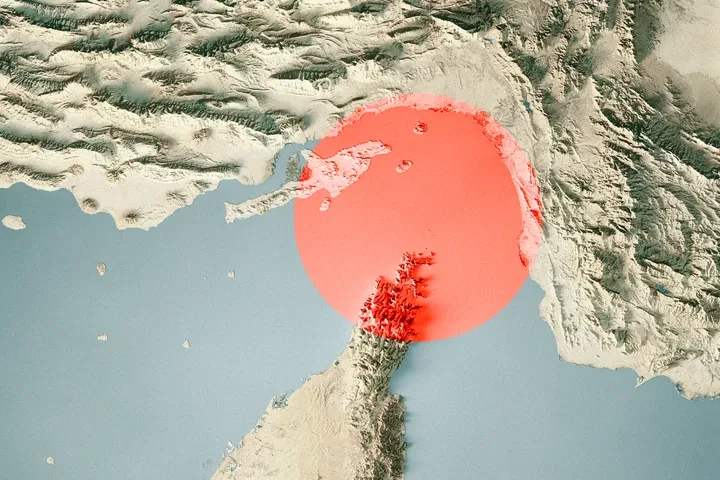
“Nature has been very kind to Donghai,” reads a plaque at the Donghai Crystal Museum, a 300,000-square-foot structure shaped like a giant, jagged crystal. Donghai sits along the Tan-Lu Fault, which runs the length of China’s eastern coastline. Over millions of years, tectonic activity created deep fractures that filled with silica-rich fluid, which slowly crystallized into large deposits of clear quartz.
For generations, Donghai’s farmers found small crystals in their farm fields and shaped them into jewelry and decorative items. After the Communist Party took power in 1949, crystal mining was brought under the planned economy, and private commercial mining was banned. The central government classified quartz as a strategic natural resource, critical for manufacturing products like optical lenses, and over time a large skilled civilian workforce grew up around the industry in Donghai. When Mao Zedong died in 1976, the founding father of the People’s Republic of China was buried in a transparent casket crafted from the highest-quality Donghai quartz.
Rural China remained deeply poor for decades; collective farming kept household incomes extremely low. After Deng Xiaoping came to power and relaxed many of the government’s strict economic controls, people suddenly gained the freedom to launch small, scrappy businesses called township and village enterprises (TVEs). Their success even caught top party leaders off guard. “Every year, township and village industries grew by 20 percent,” Deng later told a group of reporters. “This was not something I expected. Nor did the other party leaders. It took us by surprise.”
Rural communities began carving out niches in the global market. For example, Xuchang leaned into its history of making hairpieces for Chinese opera — and the willingness of rural women to sell their long black ponytails — to become a global hub for wigs. Zhuangzhai became Japan’s largest supplier of caskets, thanks in part to its proximity to forests of paulownia, a lightweight, slow-burning wood preferred for Japanese cremation rituals. Qiaotou grew into the world’s button-making capital after three brothers found a pile of discarded buttons in a gutter and decided to resell them, according to local legend.
Donghai already had abundant quartz, a skilled workforce, and entrepreneurs eager to experiment. Wu Qingfeng, a former editor at the Donghai Crystal Museum who now runs training bootcamps for aspiring crystal entrepreneurs, says that in the late 1980s, local artisans modified washing machine motors to polish crystal necklaces, a job that had previously been done entirely by hand. When local raw crystal supplies couldn’t keep up with demand, manufacturers turned to crushed glass from recycled beer bottles to make beads. Longtime locals recall that the shortage got so bad at one point that local restaurants and bars ran out of beer to serve customers.
Around the same time, illegal unregulated mining spun out of control. All the unapproved digging caused roads to cave in and houses to sink into the ground, sometimes leading to injuries and deaths, according to Chinese state media reports. In late 2001, Donghai county officials announced a sweeping crackdown on unauthorized mining. With domestic crystal supplies tightening, local entrepreneurs started traveling across the globe to source new raw material supplies. As one executive from a local crystal industry group told a newspaper at the time, “Wherever there are raw stones, you will find people from Donghai.”
Traveling to remote corners of the world wasn’t seen as a risky, bold move — it was just standard business practice, says Kyle Chan, a Brookings Institution fellow who studies Chinese industrial policy. In China, there’s “this idea, almost a kind of overconfidence, that you can go anywhere in the world and outwork and outcompete anyone else,” Chan says. Most people don’t “see cultural differences as unbeatable barriers.”
Wu Qingfeng says Donghai traders were stunned by how much raw crystal was available overseas. They learned about massive deposits across Africa, he says, after people from a neighboring province traveled there for a humanitarian aid project. Some countries had so much quartz that they were using it to pave roads. In Donghai, crystal deposits are spread thin, Wu says, “but when you go to Madagascar, Zambia, the Congo and other countries, you find local rose quartz is as common as coal — an entire mountain is made of rose quartz.”
Liu, the owner of Big Purple Crystal, says he first started traveling abroad to source amethyst around a decade ago. His first trip was to Brazil. “I bought a cheap plane ticket and brought a translator with me,” he says. “The very next day, I bought my first shipping container — around 20 tons of amethyst.” Liu struggled to turn a profit at first, so he looked for opportunities elsewhere. At the annual Tucson Gem and Mineral Show in Arizona, a massive industry gathering, he saw high-quality amethyst from Uruguay, and decided to travel there.
One entire wall of Liu’s warehouse is covered in photos of Liu posing with Uruguayan diplomats and politicians, including the former president. His biggest complaint about doing business in Uruguay, he says, is the lack of authentic Chinese food. Liu’s daughter, who studies art, now also travels to Uruguay for the family business. When local miners dig up an especially high-quality piece, she takes a photo and sends it to one of several industry group chats. “If someone wants it, it sells immediately,” Liu says. “She can flip it right away for a profit.”
The Livestreamer-in-Chief
It’s 7 a.m., and the raw crystal flea market in Donghai’s Xingxi village is already packed. Merchants sit in folding camping chairs haggling beside tarps heaped with uncut stones. Artisans lift plain-looking rocks and shine powerful flashlights through them to test clarity. A livestreamer holds a large bag of pink crystal bracelets in one hand, yelling into the small phone clutched in the other. “200 units, only 9.9 yuan!” he shouts. An elderly local man watching nearby does quick mental math — that adds up to almost $140 for just five minutes of broadcasting. There’s awe in his voice, and maybe a touch of envy too.
The livestreamer, Zhao Zhonggang, is also the Communist Party secretary of Xingxi, a village of around 4,000 people where roughly 70 percent of residents work in the crystal trade, he says. Online, he goes by the nickname “Crystal Secretary,” and posts videos of his daily life: touring the flea market to help vendors sell their goods, chatting with local elders, playing basketball with neighborhood kids. One of the biggest worries for crystal buyers is the risk of buying fakes, and few things build trust faster than an official government title. Zhao’s credibility is so strong that fans have driven across the country just to meet him in person, according to local media reports.
Zhao is a distinctly Chinese type of politician, a product of a system that evaluates officials based on how much their local area’s economy grows. In this context, the line between governing and doing business blurs completely. Zhao’s office isn’t located in a grand government building — it’s down the hall from a workshop where women string crystal bracelets by hand. Right outside his door is a stockpile of carved crystal goods: skulls, zodiac animals, and even crystal penises. (Overseas customers prefer these “odd-looking” products, one of Zhao’s employees explains. “There’s basically no market for them here in China.”)
Zhao’s career in the crystal industry started in 2012, when he became an assistant for a nearby village committee. He noticed that piles of crystal scrap from local workshops were being thrown away unused. Later, under his leadership, local villagers started repurposing the scrap into higher-value products. They arranged the small fragments into mosaic lampshades and sewed them into “healing crystal” pillows and mattresses, generating millions of dollars in sales at home and abroad.
Zhao was transferred to Xingxi in 2019. When COVID-19 lockdowns pushed most commerce online, he launched an account on Douyin, China’s domestic version of TikTok, and quickly gained a large following, helping Xingxi earn the nickname “24/7 Livestream Village.” At first, most streamers were selling primarily to domestic Chinese shoppers. But the next year, Donghai’s crystals started popping up on TikTok feeds for users across the United States and United Kingdom.
Under the glow of ring lights, TikTok livestreamers plunged metal scoops into huge buckets, dumping amethyst bracelets, chunks of lapis lazuli, and clear quartz towers into baskets and plastic bags. Signs above the mounds of sparkling crystals invited viewers to pay between $2.99 and $9.99 for their own “lucky scoop” — a random grab of crystal goods. By the end of 2022, crystals had become one of the top-selling products on TikTok Shop globally.
“The growth was explosive,” Liu recalls. “The entire crystal industry was shipping directly to the US.” Local residents opened large livestreaming “supermarkets,” where hundreds of streamers could broadcast at the same time. The local government simplified business licensing and compliance rules, and partnered with a state-owned bank to launch a foreign currency settlement program, cutting the cost of selling directly to overseas buyers.
These changes allowed Donghai to upend the traditional crystal supply chain. Instead of passing through multiple layers of wholesalers and retail stores, goods could now go straight from Donghai to international consumers, cutting out middlemen and lowering prices for buyers. “Donghai people took to the internet extremely well,” Liu says. At the height of the boom, Big Purple Crystal could sell an entire shipping container of amethyst in just one to two hours, he adds.
Wu Qingfeng, the bootcamp instructor, says this golden age only lasted a year or two. Some companies hired livestreamers with no professional experience who could barely speak English. They would say all kinds of untrue claims on camera, Wu recalls, and still sometimes make thousands of dollars a day. But eventually customers noticed that many different sellers were broadcasting from the same big facility, Wu says: “Everyone realized that you were all just one big Chinese supermarket.”
Customers started hunting for the lowest possible price, and a brutal price war broke out across Donghai. “This cross-border supermarket business turned into mutually destructive cutthroat competition,” Wu says. TikTok also began cracking down on scammy, low-quality crystal content, and even the popular lucky scoop format was eventually banned. By the summer of 2023, many small and medium-sized crystal businesses had started to go under.
The downturn has stretched on. But in Donghai, another boom always feels like it’s right around the corner. Inside one local market, a sign advertises “crystal express loans” for local merchants, with flexible repayment terms designed to keep cash flowing. At a seminar for cross-border sellers, a representative from state-owned telecom giant China Mobile promoted a service that lets companies bypass China’s Great Firewall to set up shops on international platforms like TikTok and Temu. It was billed as a government-approved alternative to VPNs, which are heavily restricted in China.
In the United States, the core strategies Donghai has used — subsidizing local businesses, building shared public infrastructure, and aggressively pursuing global market share — are viewed with deep suspicion. Instead of being seen as smart development tools, US lawmakers and pundits have framed them as unfair practices that undermine “market-oriented competition” and put American companies at a disadvantage. This rhetoric has fueled a popular narrative about China’s economic growth that is incomplete, reduced to little more than claims of malicious state interference.
But in Donghai, locals told us success more often comes from unapologetic, cutthroat competition. Imitation isn’t stigmatized — it’s seen as practical. When one person creates a new popular product (think crystals shaped like fairy wings or carved into Pokémon characters), everyone else immediately tweaks the design and starts selling their own version. “This very-fast-follower dynamic is something much deeper about China and the Chinese market,” says Chan, the Brookings fellow. Robert Wu, CEO of China-focused market research firm BigOne Lab, contrasts that with the typical American approach: “You want to do something unique, and if someone else is already doing it, you tend not to follow.”
Pressing On
Right across the street from Liu’s warehouse sits International Crystal Jewelry City Plaza, a massive shopping mall home to around 7,000 businesses selling everything from stretch bracelet cord to loose emeralds. A flea market is set up out front today, and Wu is preparing 20-some of his bootcamp students for the chaotic trading ahead.
“When you’re buying at the market, don’t ask the vendor if it’s real or fake — just don’t,” Wu tells the group. “They’ll figure out you can’t tell the difference yourself, so why wouldn’t they scam you?”
Another tip: Don’t be too quick to stock up on large inventories, because prices change constantly. White quartz, he explains, now sells for just 10 to 20 percent of its recent peak price. “What are you supposed to do with that inventory if you bought it when prices were high?” Wu asks. “How much ‘mystical energy’ would you have to add to it before you can even sell it?” He tells the students he recently heard about a crystal factory owner who bought a huge order of white quartz right before prices crashed, and ended up dying by suicide.
A few blocks away, a different glittering new industry is growing in Donghai: elaborate, gem-encrusted press-on nails. Local news outlets are calling press-ons the region’s next big signature export, part of a so-called “fingertip economy” centered on small, handmade goods designed for livestream selling and fast international shipping. One wholesaler estimates that Donghai already makes around 70 percent of all press-on nails sold in China, churning out roughly 400,000 sets per day.
At one nail shop, the walls are lined with metal racks holding clear plastic packages, each containing a set of 10 nails. There are hundreds of designs, all priced under $2. We found ourselves succumbing to the impulse to buy, grabbing set after set: shimmery pale pink nails painted with swirling koi fish, a set of long green nails with 3D lotus flowers glued to each thumb. In the corner of the store is a work station splattered with nail polish and glue, a reminder of the painstaking manual labor that goes into every finished set.
The shop’s owner, a woman in her 40s with a young daughter, tells us she makes $200,000 to $300,000 a year, an income she attributes mostly to livestream selling. Business is especially strong in niche markets like Japan and South Korea, where competition is lighter and profit margins are higher, she says. As the shop owner chats with us and sorts through paperwork, a young female livestreamer stands in front of a rack speaking Japanese into her phone. She holds up a set of nails, tilting it back and forth, as light glints across its surface. The color is a deep blue quartz hue — rich and glowing.
What Say You?
Share your thoughts on this article in the comments below. You can also submit a letter to the editor at [email protected].