How ICE’s Deceptive Tactics Gave Agents Access to a Columbia Dorm — And Why That’s Mostly Legal
In the pre-dawn hours of February 26, Department of Homeland Security (DHS) agents arrived at Columbia University’s student residential facilities. Per university accounts, the immigration officers told campus safety staff they were local police searching for a missing 5-year-old child. But once inside the dorm building, agents went straight to the room of Elmina “Ellie” Aghayeva, an Azerbaijan-born student. When Aghayeva’s roommate opened the door, agents immediately took her into custody.
At 6:30 that same morning, Aghayeva — a social media influencer with more than 100,000 followers across TikTok and Instagram — shared a photo of her legs in the backseat of a vehicle. She wrote that she had been apprehended by U.S. Immigration and Customs Enforcement (ICE) and urgently needed public help.
Columbia’s official policy bars federal agents from entering non-public campus areas unless they produce a signed judicial warrant. Most immigration arrests, however, rely on administrative warrants, which do not require a judge’s approval. This left the campus community asking one critical question: how did ICE gain access to the secure dorm? In the hours after Aghayeva’s detention, as students and faculty rallied against DHS, the answer became clear: ICE had deliberately misled campus security. What’s more, this kind of deception is, for the most part, allowed under current U.S. law.
Per reporting from Columbia’s independent student newspaper Columbia Spectator, the arresting officers never disclosed their identity as federal immigration agents to campus security staff.
This tactic is far from unusual. Experts interviewed by WIRED explain that ICE has relied on lying and impersonating other law enforcement agencies for decades. But now, as the agency receives more funding, faces higher arrest quotas, and operates with less oversight than ever before, experts warn that ICE could increasingly ignore existing legal limits on its work and use deception even more broadly.
Within hours of Aghayeva’s arrest, hundreds of protesters gathered outside the Columbia campus to condemn the action, call for her release, and voice frustration with the university’s response.
“If the university properly trained every single staff member to know how to respond to federal agents, we would all be safer,” says Susan Witte, a Columbia School of Social Work professor who joined the protest. Witte told WIRED that students and faculty have long pushed the university to mandate training for all staff on how to interact with ICE and other law enforcement groups seeking campus access.
But even robust training cannot stop ICE from misrepresenting its identity, points out Sebastian Javendpoor, a graduate student on the Arts and Sciences Student Council who also attended the protest. While the university requires campus security to only grant entry to federal agents with a judicial warrant, “that rule doesn’t stop actions like this, where DHS misleads the officer on duty,” Javendpoor says. “I’d argue that DHS agents knew campus public safety staff aren’t allowed to let them in with just an administrative warrant, so they lied to gain access.”
Aghayeva’s legal team did not respond to WIRED’s request for comment. Recent posts on her Instagram confirm she has since returned to campus and resumed sharing content with her followers.
Columbia’s acting president Claire Shipman has confirmed that immigration officers misrepresented themselves as police, calling the deception of university staff a “breach of protocol.” DHS, for its part, disputes this account.
“When our heroic law enforcement officers carry out operations, they clearly identify themselves as law enforcement,” DHS Deputy Assistant Secretary Lauren Bis told WIRED. “Regarding Elmina Aghayeva, Homeland Security Investigators verbally identified themselves and wore visible badges around their necks.”
Deceptive tactics, often called “ruses” in law enforcement circles, have long been common in U.S. immigration enforcement. Back in 1993, the Immigration and Naturalization Service (INS), ICE’s predecessor agency, lured undocumented immigrants to INS district offices by claiming they qualified for a one-time amnesty program and would receive work authorization. When immigrants arrived to pick up their cards, they were immediately arrested and placed into deportation proceedings.
“All of those people already had final removal orders issued by the government,” explains Lenni Benson, an immigration and human rights law professor at New York Law School. The strategy was partially adopted out of necessity: without a judicial warrant, Fourth Amendment privacy protections bar officers from entering a private residence without the occupant’s explicit permission, so ruses are often used to gain that entry.
After the September 11, 2001 terrorist attacks, Benson notes that the newly created DHS ramped up scrutiny of student visa holders, after it was revealed some 9/11 hijackers entered the U.S. on student visas. Even so, she says, there was no justifiable reason to use a ruse to arrest Aghayeva in her dorm. “If they knew where she lived, why didn’t they just wait for her outside the building? Why did they have to lie to get inside?” Benson asks.
In 2006, just three years after ICE was formally established, the agency released an internal memo titled Use of Ruses in ICE Enforcement Operations, written by then-Office of Investigations Director Marcy Forman and former Acting Director of Detention and Removal Operations John Torres. The memo laid out specific scenarios where ruses are permitted, and where they are off-limits. “One main objective of a ruse is to prevent violators from fleeing and placing themselves, officers, and innocent bystanders in a potentially dangerous situation,” the memo notes. Even so, the memo adds that ICE officers are barred from claiming to work for health or safety agencies like the Occupational Safety and Health Administration without explicit pre-approval from the Assistant Secretary.
While nearly all law enforcement agencies use ruses, most often in undercover work and sting operations, “this doesn’t sound like they were following any of the existing guardrails. They just picked the easiest way to get in and make an arrest,” says a former senior DHS official, who spoke to WIRED on condition of anonymity over fears of professional retaliation. “Law enforcement work is supposed to be challenging. The rules exist for a reason.”
During their time at the agency, the former official took part in policy talks about creating rules for how agents could use anonymous and fake social media accounts to interact with targets, and when agents were required to disclose their identity. “We spent so much time and so much money outlining what is and isn’t appropriate just for social media access. Entering someone’s private living space is way higher stakes,” they said.
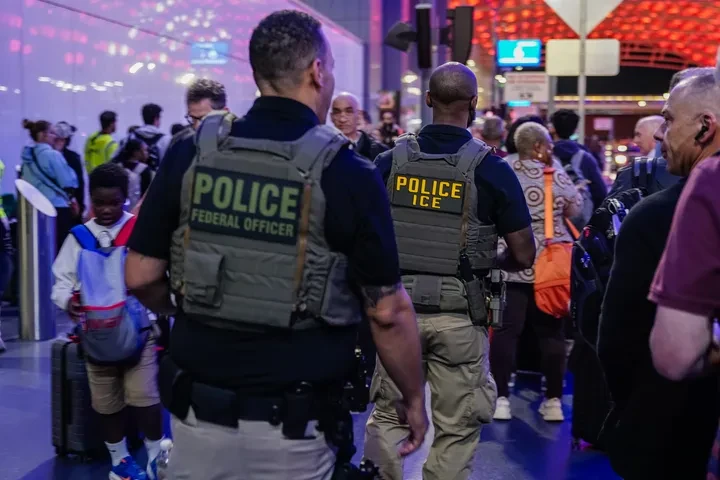
In some cases, agents argue that identifying themselves broadly as “police” is less about deception and more about clear communication. “Generally, our policy has always been that it’s better to say ‘police.’ It’s such a general term that’s understood across different cultures,” explained a former ICE officer, who also requested anonymity over fears of retaliation. “Back in the day, we were trained that saying ‘ICE’ or even ‘federal agent’ could be misheard during the chaos of an arrest.” The former officer added that agency attorneys signed off on using the term “police,” noting that “even our vests sometimes say ‘Police ICE.’” Ruses were broadly allowed as long as they did not violate the rules laid out in the 2006 memo and other internal guidance, the former officer said.
Annie Lai, director of the Immigrant and Racial Justice Solidarity Clinic at UC Irvine School of Law, argues that ruses like the one used to arrest Aghayeva strip people of their right to give meaningful consent to a search. Since most ICE arrests do not involve a judicial warrant, “they have to get people’s cooperation or permission to do what they want,” Lai says. In cases where ICE lies about its identity, “that consent isn’t real.”
Lai partnered with the American Civil Liberties Union to file a class-action lawsuit against ICE over the agency’s use of deceptive practices to enter private homes in California. As part of the ruling, a federal district judge ruled that ICE cannot identify itself as local law enforcement, and that if agents wear vests marked “police,” they must also display “ICE” in lettering of the same size.
Lai points out that most Americans do not expect someone identifying themselves as “police” to be an ICE agent. “The everyday understanding of that term is NYPD, or local or state police, the agencies people interact with on a regular basis — not federal immigration agents,” she says.
That is exactly what happened at Columbia, Lai argues: even though campus security was trained to bar ICE entry without a judicial warrant, staff never expected that the “police” asking to enter the dorms were actually immigration authorities. In response to a request for comment, Columbia spokesperson Kimberly Winston directed WIRED to public statements outlining the university’s planned updates to campus security protocols. “Personnel working frontline roles at campus gates, apartment buildings, and residence halls have received additional training to reinforce access procedures and ensure they can act confidently in line with university protocols for law enforcement access,” the statement reads. The university has also increased security patrols, and plans to install video intercom systems in all campus buildings without full-time door attendants by June 2026.
The former senior DHS official says that if ICE agents did in fact claim to be NYPD officers, that could violate existing laws against impersonating a police officer. “I think that rule applies no matter if you’re a different type of law enforcement officer,” they say. “You still can’t impersonate a specific type of officer you’re not.”
Lai adds that if ICE agents planned to impersonate NYPD, they are required to notify the NYPD in advance. (DHS’s Bis says, “They did NOT and would not identify themselves as NYPD.” The NYPD did not respond to a request for comment.)
Still, Benson worries that ICE’s deceptive tactics are becoming more and more common. “Part of the problem is that the agency isn’t being managed properly,” she says. “There’s no accountability. And the consequence of this is that it will cause systemic harm to all of law enforcement.”