The Growing Schism in MAGA: From Framing Trump as God’s Chosen to Calling Him the Antichrist
Within just a few days, prominent MAGA media personalities have shifted dramatically—once defending Donald Trump as God’s anointed pick for the presidency, they are now openly arguing he is actually the Antichrist.
These accusations reached a boiling point Sunday night, after Trump shared an AI-generated image depicting himself in a flowing white robe and red sash, resting a hand glowing with golden light on a man lying in a hospital bed. The image, which Trump removed from his Truth Social account roughly 14 hours after posting, was widely interpreted as an attempt to cast Trump in the likeness of Jesus Christ. It immediately outraged a segment of his own supporters, who framed the stunt as consistent with the Antichrist of Christian theology: a figure that opposes Christ, whose arrival many believers believe signals the end of days.
Leading voices in the MAGA ecosystem were quick to issue harsh condemnation. “It’s more than blasphemy. It’s an Antichrist spirit,” former Congresswoman Marjorie Taylor Greene posted to X on Sunday.
“In 18 months I went from hesitantly voting for Trump to thinking there’s a decent chance he’s the antichrist,” added Clint Russell, host of the right-wing Liberty Lockdown podcast.
“I genuinely believe Trump is currently demon possessed,” far-right Texas pastor Joel Webbon wrote on X. Hours later, Webbon hosted a livestream discussion titled “Is Donald Trump the Anti-Christ?”
The Knights Templar Order, a modern Christian organization modeled after the medieval military order, released a statement saying it had “no other choice but to condemn it wholeheartedly and ask for a public apology.”
For more than a decade, Trump and his allies have leaned on explicitly religious rhetoric and imagery to mobilize his conservative base. But in recent weeks, a string of controversial Trump actions—from public attacks on the Vatican to an inflammatory Iran-related post shared on Easter Sunday—have opened a major rift among his supporters that could carry lasting consequences for both Trump and the Republican Party.
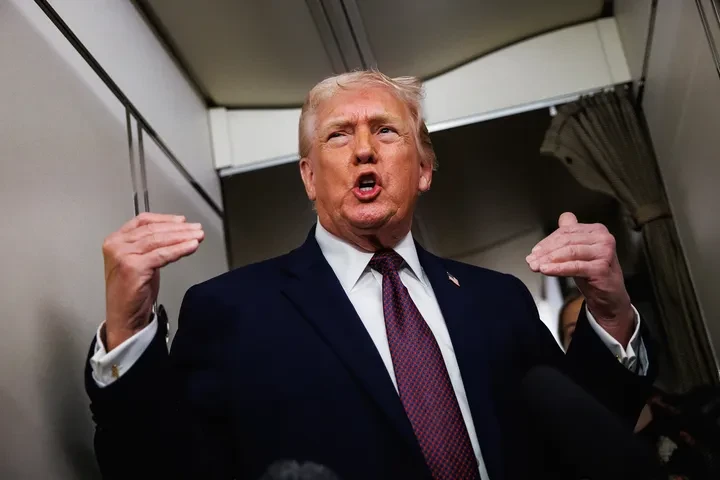
The White House did not respond to a request for comment on the backlash. During a Monday news conference, Trump denied the image was meant to cast him as Jesus, telling reporters he saw it as a depiction of himself as a doctor. “It's supposed to be me as a doctor, making people better,” Trump told reporters.
Claims that Trump is the Antichrist have been circulating among a subset of MAGA influencers for months, not just days. Last Monday, conservative pundit Tucker Carlson opened his show with a 43-minute monologue arguing that the Trump administration’s war in Iran is also a war against the Christian faith. The monologue was a direct response to an Easter Truth Social post from Trump, where the president threatened to destroy key Iranian infrastructure. (“Open the Fuckin’ Strait, you crazy bastards, or you’ll be living in Hell,” Trump wrote. “JUST WATCH! Praise be to Allah.”) Though Carlson never explicitly said the word “antichrist” during the segment, observers ranging from prominent MAGA media figure Alex Jones to users of the r/DonaldTrump666 subreddit concluded Carlson was insinuating exactly that.
This marked a stark departure for Carlson. While he has grown increasingly critical of Trump and his administration in recent months, he has long used supportive religious language to back the president. At the 2024 Republican National Convention, Carlson claimed Trump survived the assassination attempt in Butler, Pennsylvania, by “divine intervention.”
Trump himself also claimed divine intervention after the assassination attempt, as did most of his closest allies. Robert Jones, president and founder of the Public Religion Research Institute, told WIRED that Trump’s repeated framing of himself as a messianic figure has directly brought MAGA to this breaking point. “The reason why people have reached for [the antichrist label] is because Trump has actually set the stage for that himself,” Jones says.
Tensions between the Trump administration and the Vatican have also boiled over this past week. Just hours before posting the AI-generated Jesus-like image of himself, Trump slammed Pope Leo XIV on Truth Social as “WEAK on Crime, and terrible for Foreign Policy,” adding, “I don’t want a Pope who thinks it’s OK for Iran to have a Nuclear Weapon.”
While the Pope has never said he supports Iran acquiring a nuclear weapon, he has been sharply critical of Trump’s military campaign in Iran, calling the war “atrocious” and noting that the leaders responsible for the conflict have “hands full of blood.”
Trump’s latest criticism of Pope Leo comes just days after reports first emerged of a January meeting between administration officials and the Pope’s ambassador to the U.S., Cardinal Christophe Pierre. The Free Press reported that during the meeting, U.S. Undersecretary of Defense for Policy Elbridge Colby allegedly told Pierre that the Vatican needed to get on board with Trump’s military ambitions or face consequences—including a reference to Avignon, which implied the U.S. would exert pressure to displace the Pope. The Department of Defense confirmed the meeting took place but called published accounts “exaggerated and distorted.” The Vatican press office also said in a statement that some reported details were “untrue,” adding that the meeting occurred “within the regular mission of the Pontifical Representative and provided an opportunity for an exchange of views regarding matters of mutual interest.”
This is not the first time Trump has angered Catholic voters with AI-generated imagery. Last year, after the death of Pope Francis, Trump shared an AI-generated image of himself as pope. This time around, however, with Trump’s approval ratings at an all-time low and Republicans already anxious about the upcoming midterms, the political fallout could be far greater.
“It's a very politically risky move for Trump,” Jones tells WIRED. “Every time he's been on the ballot, about six in 10 U.S. white Catholics have voted for him … If he alienates Catholic voters, many of whom are core supporters, it could be very detrimental.”