Donald Trump’s Sustained Assault on the 2026 Midterm Elections: A Breakdown of Coordinated Efforts to Undermine Free Voting
Donald Trump’s rhetorical war on American election systems has only grown more aggressive and explicit as November’s midterms approach. Over the past few months, he has laid bare his anti-democratic agenda in a series of public remarks: in an interview with podcaster Dan Bongino (a former FBI deputy director who returned to media), Trump claimed Republicans “should take over the voting” in 15 key jurisdictions and “ought to nationalize the voting” nationwide. He told Reuters that “when you think of it, we shouldn't even have an election,” and told NBC News he would only accept midterm results “if the elections are honest”—a vague, self-serving standard that lets him reject any outcome he does not like. On Truth Social, he even attacked the U.S. Supreme Court for refusing “to even call out The Rigged Presidential Election of 2020,” repeating his years-old baseless lie about the 2020 contest.
Top Trump allies and congressional Republicans have brushed off widespread criticism of these remarks. When House Speaker Mike Johnson was asked about Trump’s call for nationalized elections, he claimed without evidence that election results in blue states like California are “on their face … fraudulent.”
Now, as Trump centers his legislative agenda on the restrictive anti-voting Safeguard American Voter Eligibility (SAVE) America Act—legislation that would strip millions of eligible Americans of their right to vote—what was already clear has become impossible to ignore: the Trump administration is actively threatening the integrity of the 2026 midterms. Trump does not even hide his end goal: he has openly acknowledged that “[Democrats] know if we get this, they probably won't win an election for 50 years, maybe longer.”
With public polling indicating Republicans are at high risk of losing their majorities in both the House and Senate this November, Trump and his allies are open about their coordinated, nationwide campaign to erode public trust in election systems—and lay the groundwork to reject midterm results with baseless rigging claims if they lose.
Trump’s broader project to skew elections in his party’s favor includes weaponizing the Department of Justice (DOJ) and FBI, rolling back existing voter protection laws, gerrymandering voting maps to disenfranchise minority voters, installing election deniers in key federal roles, and empowering election officials at every level to push anti-voting policies without consequence. Below is a non-comprehensive breakdown of the already active efforts by the Trump administration to target this year’s midterms:
1. The SAVE America Act
Many of the Trump administration’s efforts to undermine trust in November’s election have been consolidated into a single piece of legislation: the SAVE America Act.
The bill was crafted in response to a persistent far-right conspiracy theory that millions of noncitizens illegally cast ballots in every U.S. election. While this false claim spread widely ahead of the 2024 presidential election, all available data confirms noncitizen voting is extremely rare. A 2017 Brennan Center analysis of a dozen U.S. states found noncitizen voting made up just 0.0001 percent of all votes cast. When applied to the roughly 156 million people who voted in 2024, that equals just over 150 total illegal votes—orders of magnitude smaller than the massive numbers cited by conspiracy theorists.
An earlier attempt to pass the SAVE Act failed last year amid broad public opposition, but congressional Republicans reintroduced a revised version (renamed the SAVE America Act) in January. The initial House version would have required all voters to show specific citizenship documentation to cast a ballot. That particularly restrictive provision was removed earlier this month, but the updated bill still mandates every state pass laws requiring voters to show government-issued photo ID to vote—a change that would immediately disenfranchise millions of eligible voters who lack the required ID.
The bill also requires all new voter registrants to provide a passport or birth certificate to register. More than 20 million voting-age Americans do not have easy access to these documents. The bill narrowly passed the House, and while more than 50 Senate Republicans have signaled support, Democrats can still block it using the Senate filibuster.
Last month, Trump wrote on Truth Social that “We are going to have the Save America Act, one way or the other, after approval by Congress through the very proper use of the Filibuster or, at minimum, by a Talking Filibuster, à la ‘Mr. Smith Goes to Washington.’” More recently, he has tied passage of the bill to approving pay for Transportation Security Administration workers during the ongoing partial government shutdown.
Despite Trump’s pressure, the SAVE America Act is virtually guaranteed to fail in its current form. Senate Majority Leader John Thune has repeatedly ruled out changing filibuster rules to ram the bill through. Alongside SAVE, Republicans are pushing an even more extreme election overhaul called the Make Elections Great Again (MEGA) Act, which would eliminate universal mail-in voting and strip state governments of most control over election administration, handing that power to the federal government.
The SAVE America Act is ultimately the GOP’s attempt to codify Trump’s March 2025 executive order on elections into law. That executive order, titled “Preserving and Protecting the Integrity of American Elections,” includes most of the same provisions now in the SAVE America Act, and goes further by requiring every state give the newly created Department of Government Efficiency (DOGE) and the Department of Homeland Security (DHS) access to unredacted full voter rolls—the same data the DOJ is currently suing states to obtain. Last October, a federal court partially blocked the executive order, ruling that Trump overstepped his authority and had no legal power to alter U.S. election processes.
While the SAVE America Act may not pass Congress, dozens of officials within the Trump administration are already working to undermine election trust from inside the government.
2. Election Deniers Hold Senior Government Positions
Election deniers—activists and politicians who have spent years spreading baseless conspiracy theories about everything from “ballot mules” to noncitizen voting to erode election trust—now hold senior roles across the Trump administration.
Kari Lake, a former television host who lost two consecutive statewide races in Arizona (one for governor, one for U.S. Senate), was appointed by Trump to lead the U.S. Agency for Global Media. Lake has spent years amplifying false election conspiracy theories and has continued spreading those lies since taking her post.
In August, Heather Honey—an activist whose work fueled election denial claims and who has collaborated closely with former Trump adviser Cleta Mitchell to promote election conspiracies—was appointed to a senior role at DHS, where she oversees “election integrity” efforts.
In December, Gregg Phillips, co-founder of the prominent election denial group True the Vote and a producer of the debunked conspiracy film 2000 Mules, was appointed to a leadership role at the Federal Emergency Management Agency’s Office of Response and Recovery.
The White House also regularly consults leading figures from the election denial movement. Last May, Seth Keshel, a former Army intelligence captain who has become a celebrity within election denial circles, wrote in a Substack post that he had briefed “one of President Trump’s most critical staff members and his own key staff—someone who undoubtedly interfaces with the President daily” on his false claims. The White House declined to comment on the meeting, with an unnamed official telling WIRED at the time: “The White House does not comment on mysterious meetings with unnamed staffers.”
Beyond appointing deniers to office, Trump has also worked to absolve people who helped him attempt to overturn the 2020 election of any legal consequences. Last year, he issued “full, complete and unconditional” pardons to dozens of people who participated in his failed 2020 power grab. In recent months, he has pressured Democratic Colorado Governor Jared Polis to release Tina Peters, the former Mesa County clerk who became a conservative icon for election deniers after she facilitated a security breach of her county’s election management system during a software update. Peters was convicted of four felonies related to the breach, but Trump has waged a public campaign to secure her release—even incorrectly claiming he already “pardoned” her, despite having no authority to pardon someone convicted of state charges.
3. Open Threats of Election Day Interference
While Trump has not formally announced plans to deploy federal troops to polling places or seize voting machines, he and his administration have repeatedly suggested such actions remain on the table.
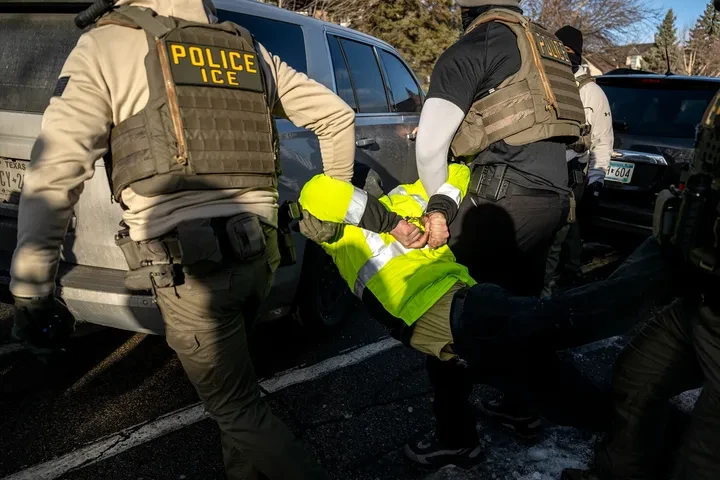
In January, Trump publicly said he regretted not ordering the National Guard to seize voting machines after the 2020 election. In early February, White House Press Secretary Karoline Leavitt told reporters that while she had not heard Trump discuss deploying federal agents to polling places, she could not “guarantee that an ICE agent won't be around a polling location in November.” Her comment came in response to former Trump White House adviser Steve Bannon’s public threat: “We’re going to have ICE surround the polls come November. We’re not going to sit here and allow you to steal the country again … We will never again allow an election to be stolen.”
Earlier this month, during his confirmation hearing to lead DHS, nominee Senator Markwayne Mullin said he would be willing to deploy ICE to polling places to respond to “a specific threat.”
The constant stream of threats and dog whistles from the Trump administration has already forced election officials across the country to run emergency simulations planning for what will happen if ICE or the National Guard shows up at their voting locations on Election Day.
Michael McNulty, policy director at Issue One, a nonpartisan nonprofit tracking money in politics, points out that the DOJ already deployed monitors to oversee elections in New Jersey and California last November, even though no federal elections were held. “The concern is that this could become a massive deployment of, quote unquote, observers by the DOJ in 2026 who might do something more, whether it's intimidation, whether it's interfering with local election officials, to get data to confirm conspiracy theories,” McNulty told WIRED.
4. FBI Raids on Local Election Offices
On January 28, the FBI raided the election office of Fulton County, Georgia, executing a search warrant that allowed agents to seize 2020 election ballots, ballot images, tabulator tapes, and full voter rolls. The unsealed search warrant affidavit reveals the FBI relied entirely on research from Kurt Olsen, a lawyer the Trump administration appointed to investigate election security last October. Olsen has a long history of working with the nation’s most prominent election deniers, including Patrick Byrne, Mike Lindell, and Kari Lake, and his claims are based on repeatedly debunked, already investigated conspiracy theories about the 2020 Fulton County election.
The raid also made headlines for the presence of Tulsi Gabbard, Trump’s Director of National Intelligence, who The Guardian reports is running a parallel 2020 election investigation with Trump’s quiet approval.
Even though there was no new evidence to justify the raid, election deniers celebrated it wildly. “You. Are. F*cked,” Kari Lake wrote on X to a Fulton County election commissioner after the raid. MyPillow CEO and Minnesota gubernatorial candidate Mike Lindell, a major funder of election denial groups, said he was “very excited,” while pro-Trump attorney Sidney Powell remarked “It’s about time.”
“This raid was based on long-debunked conspiracy theories about what happened in Fulton County,” Dax Goldstein, director of the election protection program at nonpartisan democracy group States United Democracy Center, told WIRED. “But nonetheless, DOJ is continuing to use its immense power to advance tired lies. And that causes real harm, because DOJ has unique tools that run-of-the-mill conspiracy theorists don’t.”
The FBI’s focus on rehashing 2020 election falsehoods expanded on March 5, when the agency issued a grand jury subpoena seeking information as part of an investigation into the widely debunked Cyber Ninjas audit of the 2020 election in Maricopa County, Arizona.
5. The Push for a National Voter Database to Purge Eligible Voters
Since May, the Trump administration, led by Attorney General Pam Bondi, has demanded unprecedented access to state voter rolls, refusing to give a clear explanation of how the data will be used or who it will be shared with.
So far, the administration has had partial success: 10 states, home to roughly 37 million eligible voters, have already turned over the requested data, which includes driver’s license information and partial Social Security numbers. When states have refused to comply, the DOJ has sued: 24 states have been sued to date. In late January, just days after a citizen named Alex Pretti was shot and killed by federal immigration agents, Bondi used the incident to pressure Minnesota to hand over its voter rolls—a demand a state attorney described as a “ransom note.”
States that have turned over their data were also forced to sign a confidential memorandum of understanding that lays out the Trump administration’s plan to “test, analyze, and assess” the data and order states to remove specific voters from the rolls. This is a complete reversal of how U.S. elections have traditionally been run, where states control their own voter roll maintenance.
“Instead of taking a perspective of enforcing federal law and protecting individuals’ rights to vote, the [DOJ Civil Rights] division is really focusing on executing on the president's priorities, which are fueled by conspiracy theories and anti-voting groups' narratives,” Goldstein told WIRED. “It's a 180-degree turn.”
Under the agreement, states have just 45 days to remove voters the federal government flags, a requirement that likely violates the federal National Voter Registration Act, which requires states to wait two full federal election cycles before removing a voter from the rolls.
These efforts have already emboldened local Republican election officials across the country: In September, the chair of the Republican-led North Carolina State Board of Elections sent a letter to the state DMV demanding access to voters’ full Social Security numbers. In January, the board outlined plans to label voters “presumptive noncitizens” based on notoriously unreliable federal database data, a move that could lead to thousands of eligible voters being purged from the rolls. The board also voted to remove early voting locations from three North Carolina public universities, despite large public protests against the decision.
6. The Ongoing War on Mail-In Voting
Ironically, Trump has repeatedly used mail-in voting himself, and even encouraged his own supporters to use mail-in ballots ahead of the 2024 election—but he has spent years spreading baseless conspiracy theories about mail-in voting security.
Last August, Trump made clear his goal is to eliminate mail-in voting entirely. “We're going to start with an executive order that's being written right now by the best lawyers in the country to end mail-in ballots because they're corrupt," Trump told reporters in the Oval Office. Just this week, he once again called mail-in voting “cheating”—just days after he personally voted by mail in a Florida special election.
Like House Speaker Johnson’s unsubstantiated claim that ballots are “magically whittled away” in Democratic areas, Trump’s claims are rooted in the conspiracy theory that Democrats use mail-in voting to rig elections. In reality, Republicans are far less likely to use mail-in voting, in large part because of Trump’s repeated demonization of the process. That means when mail-in ballots are counted on or around Election Day, they typically skew Democratic—creating the false impression of fraud for those looking for a conspiracy.
Earlier this week, the U.S. Supreme Court heard oral arguments in a case brought by the Republican National Committee that asks the court to throw out any mail-in ballots that arrive after Election Day, even if they were postmarked before Election Day. The change would disenfranchise hundreds of thousands of voters, and the court’s conservative majority appeared open to siding with the RNC.
7. Redrawing Congressional Maps to Lock in GOP Control
Trump administration officials have pressured Republican-led states to redraw their congressional districts to stop Democrats from retaking control of Congress in the midterms. When Trump launched his redistricting push last June, he hoped it would net his party a dozen or more House seats. But legal pushback and Democratic counter efforts mean any gains will likely be far smaller, and extreme gerrymandering has left some Republican incumbents more vulnerable than before.
While Republican-led states including Texas, North Carolina, and Missouri have complied with the administration’s demands, any gains they make could be offset by redistricting in Democratic-led states like California, which has redrawn its own maps to favor Democrats.
The 1965 Voting Rights Act (VRA) is the main federal law that blocks states from enacting discriminatory redistricting plans. The Supreme Court already gutted the VRA’s key enforcement provisions in 2013 by eliminating federal pre-clearance of election rule changes in states with a history of discrimination. Now, the court—stacked with conservative justices appointed by Trump—appears poised to further weaken the VRA by effectively eliminating Section 2, the provision that bans discriminatory districting. Weakening or eliminating Section 2 would allow the GOP to redraw districts freely, drastically reducing the voting power of Black, Latino, and other minority voters.
8. Additional Coordinated Efforts to Undermine Election Integrity
DOGE Collaboration With Anti-Voting Conspiracy Groups
In a January court filing, the Social Security Administration (SSA) admitted that a DOGE employee signed a “voter data agreement” with an unnamed “political advocacy group.” The agreement gives the group access to SSA data, and the group’s stated goal is to find “evidence of voter fraud and to overturn election results in certain States.” Multiple outlets have speculated the group in question is True the Vote, since the group publicly appealed to DOGE employees to collaborate on exactly this kind of project when the agreement was signed in March 2025. But True the Vote co-founder Catherine Engelbrecht denied her group was involved in a newsletter earlier this year.
DOJ’s Voting Rights Section Gutted and Remade to Push Election Denial
Within months of Trump’s second inauguration, the DOJ’s Civil Rights Division voting section got a new mandate: stop protecting voter access, and instead focus almost exclusively on investigating unproven claims of voter fraud. The change aligns the section with Trump’s stated priorities, and reorients its work around 2020 election conspiracy theories, according to an internal memo obtained by the Associated Press.
In the months since the change was made, nearly all experienced attorneys who previously worked in the voting section have left. The departing attorneys all had decades of experience with federal election law, and they have been replaced by lawyers with little to no experience in federal court, according to anonymous sources who spoke to WIRED. Most of the new lawyers hired to work in the voting section have ties to election denial groups or actively worked to help Trump overturn the 2020 election results.
The current acting head of