Federal Judge Rules ICE Agents Violated Fourth Amendment in Forcible Unwarranted Home Entry
Last Saturday, a federal judge in Minnesota ruled that agents from U.S. Immigration and Customs Enforcement (ICE) violated the U.S. Constitution’s Fourth Amendment when they forcibly entered a local man’s home without a judicially signed warrant. The agents’ conduct aligns nearly perfectly with a previously undisclosed internal ICE policy that claims agents are legally permitted to enter private homes using an agency-issued administrative warrant, rather than a warrant approved by an independent judge.
U.S. District Court Judge Jeffrey Bryan issued the ruling in response to a January 17 petition for a writ of habeas corpus. While the decision did not directly rule on the legality of ICE’s internal guidance itself, it clearly established that federal agents violated constitutional law when they entered the private residence without consent and without a judge-signed warrant. That exact standard — that an administrative warrant is sufficient for home arrests — is what ICE leadership has privately told its officers is acceptable, according to a complaint filed by Whistleblower Aid, a nonprofit legal group that represents whistleblowers from both the public and private sectors.
Gibson’s Account of the Raid
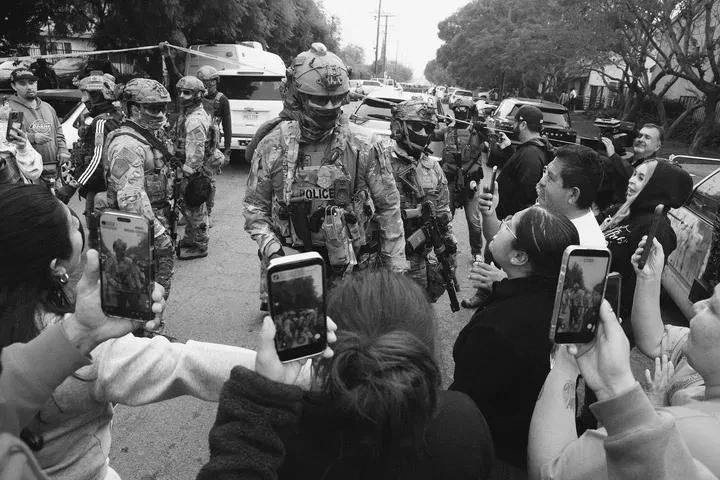
In a sworn declaration, Garrison Gibson, a Liberian national who has lived in Minnesota for years under an ICE order of supervision, recalled that agents arrived at his home in the early morning of January 11, while his entire family slept inside. Gibson says he refused to open the door and repeatedly demanded agents show him a judicial warrant. Per his account, agents left initially, but returned with a larger team. They deployed pepper spray against neighboring residents who had gathered outside to observe the interaction, then used a battering ram to force open the front door.
Gibson’s declaration was filed as part of a January 12 Minnesota state lawsuit against Homeland Security Secretary Kristi Noem, which challenges federal immigration enforcement operations across the Twin Cities. State officials characterize these operations as an unconstitutional “invasion” by ICE and other federal agents that has roiled communities in Minneapolis and Saint Paul.
Notably, federal officials did not contest Gibson’s habeas petition.
Gibson, who fled the Liberian civil war as a child, says agents entered his home without ever showing a warrant at the time of entry. His wife, who recorded the interaction, warned agents that young children were inside the home, he says, while armed agents holding rifles stood in his doorway. “One agent repeatedly claimed ‘We’re getting the papers’ in response to her demand to see the warrant,” Gibson said. “But without showing a warrant, and apparently without having one at all, five to six agents moved in as if they were entering a war zone.” He added that agents only showed an administrative warrant to his wife after he had already been handcuffed.
Re-Arrest Follows Court-Ordered Release
Just one day after the judge ordered Gibson’s immediate release, ICE agents took him back into custody when he appeared for a routine immigration check-in at a Minnesota immigration office, according to his attorney Marc Prokosch. Gibson arrived at the check-in believing the court order had resolved his case, Prokosch added.
“We were there for a check-in, and the original officer said, ‘This looks good, I'll be right back,’” Prokosch told the Associated Press. “And then there was a lot of chaos, and about five officers came out and then they said, ‘We're going to be taking him back into custody.’ I was like, ‘Really, you want to do this again?’”
The re-arrest does not reverse the court’s finding that ICE violated the Fourth Amendment during the unwarranted home entry, but it underscores how the agency retains civil detention authority even if a judge rules a specific arrest was unconstitutional.
Court records reviewed by the Associated Press show Gibson’s criminal history consists of only a single felony conviction from 2008, plus minor traffic violations and low-level arrests. That 2008 conviction, which ICE cited in Gibson’s removal order, was later dismissed by courts, records show.
| Got a Tip? |
|---|
| Are you a current or former government employee who wants to share information about U.S. immigration enforcement? We'd like to hear from you. Using a nonwork phone or computer, contact the reporter securely on Signal at
dell.3030. |Prokosch did not immediately respond to a request for comment for this report.
To clarify: An ICE administrative warrant is typically signed by an ICE supervisor, not an independent judge, and authorizes the arrest and detention of a noncitizen for immigration purposes. This type of warrant is valid for taking someone into custody in public, or for entering a private dwelling when consent has been given, but it is not a judicial search or arrest warrant and does not authorize nonconsensual entry into a private home.
ICE’s Internal Policy Draws Constitutional Scrutiny
Judge Bryan’s ruling comes as new scrutiny falls on the previously undisclosed ICE legal directive centered on Form I-205, an internal administrative document known as a “Warrant of Removal/Deportation.” According to materials disclosed by Whistleblower Aid, the memo instructs ICE officers that a signed I-205 — which is issued by the agency, not a judge — is sufficient authority to enter a person’s home to carry out an arrest, even without the resident’s consent.
The guidance was circulated internally and briefed verbally to officers, the whistleblower complaint alleges, and has drawn alarm from civil liberties advocates who argue it conflicts with long-standing Fourth Amendment limits on warrantless home entry.
In a recent analysis, Orin Kerr, widely regarded as one of the nation’s leading Fourth Amendment scholars and author of top law review articles on search-and-seizure doctrine, wrote that ICE’s position conflicts with decades of established constitutional limits, noting that “the executive branch can’t be in charge of deciding whether to give itself a warrant.”
Kerr warned that allowing executive-issued warrants to justify home entry would undermine the judicial check the Fourth Amendment is meant to impose, writing that such warrants lack the “neutral and detached” review required before the government can cross the threshold of a private residence.
After his initial arrest, Gibson says in his declaration that he was taken to a local detention facility where ICE agents posed for humiliating trophy photos. “Once there, agents posed with their personal cell phones taking selfies standing on either side of me with their thumbs up,” he said. “I observed them take similar photos with other detainees. This, to me, seemed designed to humiliate the detainees and create ‘trophy’ photos.”
The facility, the Bishop Henry Whipple Federal Building, houses ICE operations in Minnesota and has become a focal point for protests and community attention amid aggressive federal immigration enforcement operations.
ICE acknowledged a request for comment but did not provide a substantive response before publication. In a statement Thursday, Homeland Security spokeswoman Tricia McLaughlin told reporters that people served with administrative warrants have already received “full due process and a final order of removal,” and claimed the officers issuing the warrants “also have found probable cause.”
Judge Bryan’s ruling implicitly rejects that view. Absent pushback from the government, he ordered Gibson’s immediate release, adding that the agents had “forcibly entered [Gibson’s] home without his consent and without a judicial warrant,” concluding bluntly: “This arrest violated the Fourth Amendment.”