One Year Into Trump’s Second Term, Extremist Militias Are No Longer Needed To Carry Out Mass Deportation
One year ago, when Donald Trump secured a second term as U.S. president, violent militia members and far-right extremist groups that spent years peddling the false claim the 2020 election was stolen stood ready to help the president deliver on one of his core campaign pledges: large-scale mass deportations.
“I’m willing to help,” Richard Mack, a former sheriff and founder of the far-right Constitutional Sheriffs and Peace Officers Association, told WIRED at the time. Mack claimed he was already in contact with Tom Homan, the figure Trump tapped to serve as his administration’s “border czar.” Tim Foley, leader of Arizona Border Recon—a group that brands itself as a nongovernmental organization—also confirmed to WIRED he had been in communication with senior Trump administration officials. William Teer, then the head of the far-right Texas Three Percenters militia, went a step further, sending a formal letter to Trump offering his group’s assistance. The Southern Poverty Law Center later uncovered that Homan even met with a Proud Boys affiliate shortly after the 2024 election, and meeting records indicate the pair discussed logistics for deportation operations.
Despite all these militia leaders and far-right factions salivating over the chance to be deployed to U.S. city streets to round up immigrants at gunpoint, the formal call to action they waited for never arrived.
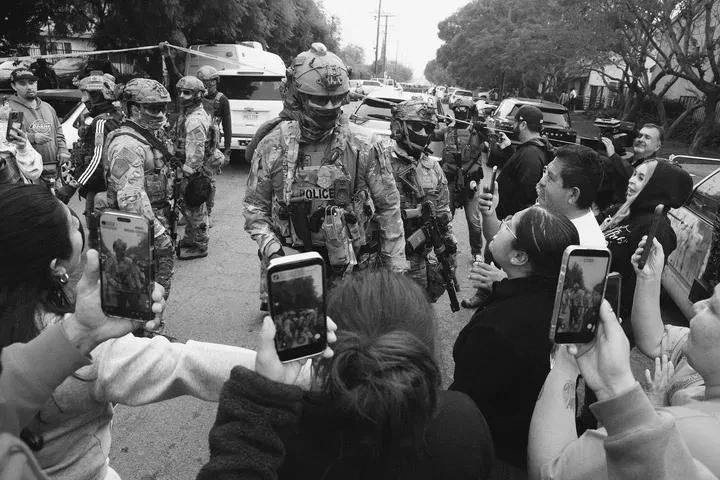
Instead of leaning on outside extremist groups, the second-term Trump administration has reshaped the federal government so thoroughly that it no longer needs unofficial far-right formations to intimidate and terrorize immigrant communities across the country. It now relies on a dramatically expanded federal enforcement network that includes agents from Immigration and Customs Enforcement (ICE), Customs and Border Protection (CBP), the FBI, the DEA, state and local law enforcement, and more. This newly enlarged force has been emboldened both by a massive flood of new funding and by quiet, implicit approval from the White House to take any action they deem necessary to hit Trump’s aggressive deportation targets.
“What we’re seeing right now is the Trump administration effectively realigning the federal government to support mass deportation,” says Nayna Gupta, policy director at the American Immigration Council. “This has meant diverting law enforcement resources from agencies that have never before handled low-level immigration arrests, so that they are now focused exclusively on profiling and arresting immigrants.”
While the last 12 months have already been devastating for immigrant communities across the U.S., experts warn the worst harm is still ahead. They note that putting CBP—an agency with a well-documented history of alleged human rights violations—at the center of the immigration crackdown is an especially troubling sign.
“I think we’re just at the beginning,” says Naureen Shah, director of government affairs at the American Civil Liberties Union. “I think we ain’t seen nothing yet. They will scale up dramatically in the coming months.”
Trump campaigned in 2024 on a promise to launch the “largest deportation operation in the history of our country” during his second term, and within days of returning to the Oval Office in January, he signed multiple executive orders designed to fulfill his supporters’ demands.
Tasked with carrying out Trump’s deportation agenda was Department of Homeland Security (DHS) Secretary Kristi Noem, who spent the early months of the administration performatively role-playing as an immigration enforcement agent. She was aided by Homan and her “shadow secretary” Corey Lewandowski. But behind closed doors, immigration policy is dictated by White House Deputy Chief of Staff for Policy Stephen Miller, who has a long public history of promoting white nationalist ideology. In recent months, this administration has greenlit raids at previously protected locations including schools, courthouses, and hospitals; deported people to countries they have no connection to without due process; and arrested local elected officials who push back on enforcement. When communities fought back, the administration deployed the military to U.S. city streets to counter an almost entirely non-existent threat of violence from protesters.
Then in July, as part of his signature “One Big Beautiful Bill” spending package, Trump approved $170 billion to fund immigration and border enforcement over the next four years, $75 billion of which goes directly to ICE. No volunteer militia leaders or anti-immigrant outside extremists are needed.
After the bill passed, the nonprofit American Immigration Council concluded the “new infusion of money [makes] ICE the highest-funded federal law enforcement agency in history.” It would “bring the administration’s effort of repurposing the federal government to focus primarily on immigration enforcement close to reality,” the council wrote.
Seeking to capitalize on the climate of terror it has created for immigrant communities, official White House and DHS accounts document their actions by posting videos, memes, and low-quality AI-generated content—much of which is only understandable to audiences embedded in extremist spaces—to their official social media channels.
Richard Mack, who claims to have been in touch with Homan as recently as this past fall, has not played any official role in the deportation effort. But local sheriffs and other law enforcement agencies have been co-opted into doing ICE’s work for the agency: that includes interrogating anyone they suspect of being in the country illegally, demanding proof of citizenship, arresting undocumented immigrants, and detaining them in local jails until ICE agents arrive to transfer them. Homan did not respond to a request for comment.
“They’re not only cannibalizing the federal government, they are building out their tentacles in cities and states across the country through a radical expansion of the 287(g) program, which taps state and local law enforcement to support immigration enforcement,” Shah says.
A year ago, just 125 agencies had signed up for 287(g) programs. As of November 25, that number had skyrocketed to more than 1,200. “They’re trying to treat it as miniature ICE outposts all across our communities,” Shah adds.
And yet, despite everything the Trump administration has done to expand deportations, it has not satisfied a hardline cohort of the president’s base.
“The administration is not serious,” Nick Fuentes, a far-right white nationalist influencer who recently sparked a civil war within the GOP, said in October, criticizing the administration’s deportation numbers.
A November report from the conservative Heritage Foundation think tank reached the same conclusion, pointing out that the Trump administration was “substantially off pace” to meet its stated goal of exceeding the scale of President Dwight Eisenhower’s 1954 deportation program. To remedy this, the report suggests adopting a broader approach targeting all undocumented immigrants by dramatically increasing worksite enforcements—or copying the Eisenhower administration’s method of using a “system of blocking off an area and mopping it up.”
DHS has claimed deportations in Trump’s first year back in office will shatter records, but verifying this claim is nearly impossible, as the agency stopped publishing monthly deportation figures shortly after taking office. Internal numbers obtained by NBC News show ICE deportations are still well below Trump’s predicted targets.
In late October, the administration sought to speed up deportations by replacing ICE personnel with CBP agents in leadership positions across the country, an unprecedented use of agents who are typically tasked only with patrolling the Mexican and Canadian borders.
“Border Patrol is an agency with a culture of abuse and impunity,” says Shah. “They have for years harmed people and even killed people and not faced accountability for it. They are bringing their culture of abuse and xenophobia and their sense of impunity to American cities deep into the interior, and it is a recipe for disaster for our civil rights.”
Explaining the decision at the time, a DHS official told NBC News: “The mentality is, CBP does what they’re told, and the administration thinks ICE isn’t getting the job done. So CBP will do it.”
Leading the new interior enforcement charge is Border Patrol agent Greg Bovino, who gained notoriety for his role in some of the most infamous anti-immigrant actions of Trump’s second term. That includes leading a group of agents on horseback, supported by military personnel, into Los Angeles’ MacArthur Park while children were playing in the public space. He also led deportation actions in Chicago, where he was captured on video throwing tear gas into a crowd of community members.
In a November ruling extending an injunction limiting excessive force by ICE and Border Patrol agents in Chicago, U.S. District Court Judge Sara Ellis wrote that she found Bovino’s testimony “not credible,” adding that he “appeared evasive over the three days of his deposition, either providing ‘cute’ responses to Plaintiffs’ counsel’s questions or outright lying.”
Initially, experts worried that having far-right Constitutional Sheriffs working directly with ICE would lead to widespread human rights violations, but those harms would have been isolated to the specific counties where those sheriffs operated. CBP, on the other hand, is a federal agency that now has a formal mandate to operate across the entire country.
“Bovino has a terrible track record of obvious anti-immigrant rhetoric and action, and Border Patrol has a long-standing history of abuses and impunity and no experience in enforcing immigration law in the interior of the United States,” says Gupta, pointing out that it’s “unprecedented to have Border Patrol officers in cities like Charlotte or Chicago or New York making at-large arrests in communities that have long-standing ties to this country.”
The scope and scale of CBP’s activity continues to grow, with recent revelations that the agency has monitored the travel patterns of millions of Americans to flag what it classifies as suspicious activity.
Meanwhile, ICE continues to expand its own reach, building an off-the-books deportation network in Texas and contracting with bounty hunting firms to track immigrant targets. As WIRED exclusively revealed earlier this year, operatives from Elon Musk’s so-called Department of Government Efficiency are building a massive centralized database at DHS that could be used to surveil undocumented immigrants across the country.
Experts who spoke to WIRED point to mass protests like the nationwide No Kings marches, and state-level leaders like Illinois Governor JB Pritzker standing up to ICE, as signs of hope that Trump’s mass deportation push could be scaled back or ended. But ultimately, Shah says, as long as Miller remains in his policy role, very little is likely to change. The White House and Miller did not respond to requests for comment.
One year ago, experts warned about the potential for isolated incidents of overreach by extremist sheriffs tied to immigration enforcement. Today, those concerns are moot, given how radically the Trump administration, orchestrated by Miller, has reshaped the federal government to execute their deportation demands.
“The thing that could stop this is if Stephen Miller is no longer at the helm,” says Shah. “He’s the evil genius, and as long as he has power, he can keep moving the chess pieces. It doesn’t matter if it’s Tom Homan or Kristi Noem or Corey Lewandowski, all these people are just pieces on the board.”