The Fight Against ICE Inside Tech: "The Stakes Are Too High Not to Speak Up"
The first Trump term, and the tech industry that pushed back against it, feels more outdated and innocent with each passing day.
One stark example makes this shift impossible to miss: Back in 2017, when then-President Trump signed a series of executive orders barring entry for foreigners from several majority-Muslim countries, Americans across the country rallied to protest the policy. Among the most vocal opponents were some of tech’s biggest names: Google co-founder Sergey Brin joined a public demonstration at San Francisco International Airport; Amazon founder Jeff Bezos sent a company-wide email laying out the “legal options” Amazon was exploring to challenge the ban; Facebook founder Mark Zuckerberg took to Instagram to share his own family’s immigrant roots and condemn the order.
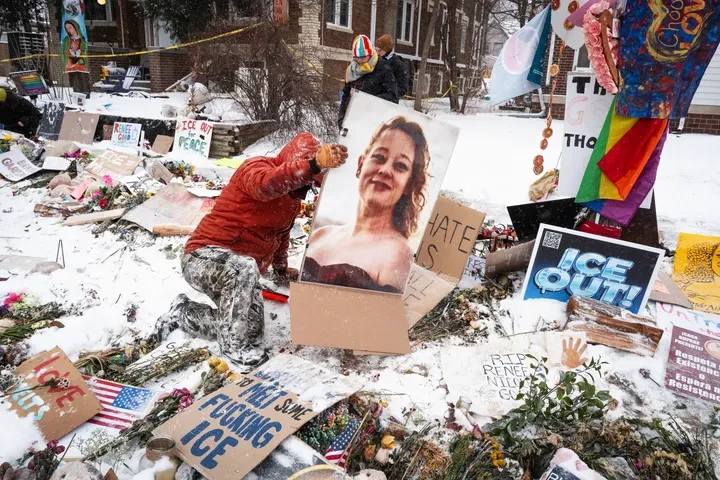
How dramatically things have changed. This past Saturday, just hours after federal agents shot and killed ICU nurse Alex Pretti on the streets of Minneapolis, dozens of high-profile tech executives gathered at the White House for a private screening of Melania, a new documentary distributed—ironically enough—by Amazon MGM Studios. The jarring timing did not go unnoticed by the group of Silicon Valley workers behind ICEout.tech, a new campaign centered on an open letter to tech industry leaders. Launched earlier this month after the killing of Renee Nicole Good, the letter has now garnered more than 1,000 signatures from tech workers across Big Tech firms and startups alike. The workers are calling on executives to leverage their influence to demand that Immigration and Customs Enforcement (ICE) withdraw from U.S. cities, terminate all existing company contracts with the agency, and publicly condemn ICE’s pattern of violent, deadly tactics.
Worker-led political demands like these were standard during the first Trump administration, when employees at the world’s largest tech companies frequently spoke out—both internally and publicly—about the administration’s cruelty, and the tech industry’s role in either enabling or pushing back against its most extreme policies. Today, though, a movement like ICEout.tech feels genuinely radical: Tech workers have been strikingly quiet over the past year, as power inside most tech companies has shifted sharply toward management and away from rank-and-file staff. Meanwhile, industry leaders have been falling over themselves to curry favor with the current administration, from private White House dinners to backing expensive, little-seen political projects that align with its agenda.
Could this finally be the moment that breaks the silence? This week, several top Silicon Valley leaders—including Anthropic co-founders Dario and Daniela Amodei, OpenAI CEO Sam Altman, and Apple CEO Tim Cook—finally spoke out against ICE’s blatant overreach. It’s a small first step, but I wanted to dig deeper into what’s shifting inside tech circles, and where the industry goes from here. So I invited two early signatories of the ICEout.tech letter, Moonshine AI CEO Pete Warden and Gatheround co-founder Lisa Conn, to join me for an emergency episode of The Big Interview. What follows is a transcript of our conversation, edited for length and clarity.
Katie Drummond: Pete and Lisa, thank you so much for making time to join me today. I’m thrilled you could be here.
Pete Warden: Great to be here.
Lisa Conn: Thanks for having us.
Drummond: You both have long careers in tech, and you’re two of the thousands of tech workers who’ve added your names to the widely circulated ICEout.tech open letter. The movement and website launched earlier this month, right after the tragic killing of Renee Nicole Good. What pushed you to put your name to this letter? Right now, speaking out publicly like this in the tech industry is no small risk.
Conn: I signed for a whole host of reasons, but the core one for me is that this crosses a fundamental line. When the government starts killing people in the streets, then covers up what plain evidence shows happened, we’re staring down a crisis of both governance and economy. This is a deeply unstable situation that hurts everyone doing business here.
Think about it just from an economic perspective: When this kind of violence and impunity becomes normalized, capital pulls out. Top talent leaves. And it can take decades for a region to recover that reputation. Businesses don’t thrive when employees are scared for their safety and entire communities are terrorized. Tech hubs and tech leaders are especially vulnerable here, because our talent is incredibly mobile. People can and will leave, start companies elsewhere, take their jobs to other places. This isn’t some hypothetical future—it’s unfolding right in front of us. Yeah, there’s risk of retaliation from the current Trump administration, and pushback within the tech community, but the stakes of staying silent are far higher than the risk of speaking up. For me, putting my name to this was an obvious call.
Drummond: Pete, what about you?
Warden: I share a lot of the reasons Lisa laid out, but what pushed me over the edge was seeing the courage of people in Minneapolis. They’re literally putting their own bodies on the line, risking violence, to protect their neighbors. It felt unacceptable that no one in tech was willing to risk even a small hit to their career to do whatever we could to stop this violence and save lives. This was the absolute minimum I could do.
I spent five years at Apple and seven at Google, and I know so many of my former colleagues are too scared to speak up. I’m a startup founder, so even if I face retaliation and can’t raise funding for my company—because people like Marc Andreessen hold enormous sway in this industry—I won’t get fired. A lot of other people don’t have that safety net, and they’re right to fear losing their jobs for speaking out.
Drummond: I want to ask you both about the shift you’ve seen in tech from the first Trump administration to today. How would you describe how tech leadership has shown up now versus then? What about workers? What’s changed in the past decade?
Conn: There’s been a really dramatic shift of power away from employees, not just in tech but across most industries. Up until around 2021, retaining top talent was the number one business priority for almost every tech company. Talent was seen as the most valuable asset, and companies couldn’t hire fast enough to keep up. Perks were everywhere, mass layoffs were rare—they were seen as a sign of bad leadership and CEO failure, even. Mark Zuckerberg famously bragged for years that Meta had never done layoffs. So employees had real leverage back then. We saw that in 2020, after George Floyd’s murder, when the racial justice movement was at its peak: Employees put massive pressure on employers to issue statements, take stands, and speak out. A lot of that was performative, some was genuine, but it was clear employees had a lot of power to force change.
Then the economy shifted, and companies started laying off tens of thousands of workers starting in 2021 and 2022. Suddenly, retaining employees wasn’t a top priority anymore, so employees lost most of that leverage. Coinbase was a really early example of this shift: It was one of the first big companies to announce mass layoffs, and CEO Brian Armstrong was one of the first major leaders to ban political discussion in the workplace entirely. So there was this big correction in 2021 and 2022 where companies were far less willing to listen to employees, because it just didn’t matter as much if employees left—if anything, layoffs were saving companies money on severance. That’s the biggest shift in worker power in tech, and I think most other industries too. I expect this will shift back eventually, these cycles always do, but right now we’re still in a period where employee power is way lower than it was 10 years ago, or even five years ago.
Warden: I’d add another layer to that: The current administration is far more willing to retaliate against industry leaders who step out of line. If you’re the CEO of a big tech company and you don’t toe the line, you’ll be targeted, and the full power of the federal government will be used against you in a vindictive way. In some ways I actually sympathize with these CEOs—no one ever expected to have to choose between exercising free speech and watching their entire company be destroyed.
At the same time, it’s worth asking how much of the opposition we saw from tech leaders between 2016 and 2020 was sincere, and how much was just performative. I wonder if a lot of these leaders see the current moment as an open invitation to act on what they’ve actually believed all along.
Conn: I’m generally an optimist, and I tend to think most people are good—when they act badly, it’s usually because of their circumstances, not some inherent evil. As a founder myself, I’ve seen firsthand that for a lot of tech CEOs, especially founder CEOs, the company becomes their ideology at a certain point. Protecting the company, keeping it safe, growing it, protecting employees, shareholders, and investors—that becomes their core motivating principle.
When cultural and power dynamics make it easier to take a stand on one side of an issue, they speak up. When taking a stand could hurt the thing that feels like life or death to you as a founder, it’s much harder to speak out critically. I don’t believe that tech CEOs have completely changed their core values and ideals in a decade. That’s not how people work, from everything I know about how people change their minds. It’s not that this moment is giving them permission to be their “true” selves—it’s just that staying silent is better for their companies in 2026. But what makes this moment so important is that two weeks ago that might have been true, but I don’t think it’s necessarily true anymore.
Another big difference between 2016 and now that we haven’t talked about is how much more brutal this Trump administration is, how much more open and blatant the corruption is. There are so many policies that hurt the tech industry directly: Funding for scientific research, the foundation of our entire industry, has been gutted. Economic stability is at risk, our ability to attract global talent is damaged—all of these things hurt tech companies, and that damage will only get worse if this continues. I think we can get the CEOs of the top 10 tech companies to speak up when their own businesses are on the line.
Drummond: Pete, anything you’d add to that?
Warden: I can’t speak to what’s in anyone’s heart, but there’s been a broader cultural shift too. We used to put tech startup founders on a pedestal—they were almost universally admired, everyone thought what they were doing was cool and innovative. Then tech “won” and became the most dominant industry in the economy, and that brought a whole new level of accountability, and a lot more pushback from people who don’t agree with everything the industry does. That shift from being the scrappy underdog that got a lot of leeway to controlling huge swathes of the economy means you get a lot more criticism. I think that was a shock to a lot of top tech CEOs, who were used to glowing coverage from the media and the public. Suddenly they’re being treated the same way we treat the CEO of Exxon or any other big corporate leader, and that had to be a jolt.
Conn: It’s really hard for people to let go of that underdog self-image. When you see yourself as an underdog punching up at power, a little aggression doesn’t feel that bad. But when the world sees you as the powerful bully punching down, it looks completely different. That mismatch between how they see themselves and how the world sees them makes it really hard to adjust.
Drummond: Lisa, you mentioned earlier that the recent violence in Minneapolis tipped the scales and changed the conversation. I’m curious what you’ve both been hearing from colleagues over the past few weeks. What are people saying, what are they worried about, how is this landing?
Conn: One thing that really stands out is that this isn’t just a left-wing issue. We have an incredibly broad coalition. We’ve heard from people who identify as moderates, independents, libertarians, even Republicans, and people who’ve never been politically active before in their lives. We’ve seen people across every role—engineers, CEOs, board directors, VPs, staff at Big Tech, researchers at AI labs, startup founders, even VCs—who’ve been uneasy with this administration from the start, but these violent attacks on civilians and the crackdown on dissent have been a breaking point. In the 18 or 19 days since we started circulating the pledge, we’ve seen exponential growth in signatures and interest from people across all political stripes and all job roles in tech. That’s what makes this movement different from past efforts.
Warden: Even people who don’t follow politics closely—and I totally get why people would want to tune out all the chaos of the past few years—couldn’t ignore what happened in Minneapolis. People just saw it for what it is: obviously wrong. That’s the big shift I’ve seen in conversations with people across the political spectrum—everyone can agree on this basic point.
Drummond: When WIRED first covered this open letter a couple of weeks ago, you had a few hundred signatures. Now you’re over 1,000 in just a matter of days, which is really impressive. But the tech industry is massive—Amazon alone employs more than a million people in the U.S. Pete, you talked earlier about fear. Why isn’t this list in the tens or hundreds of thousands by now? Where is everyone else?
Warden: The fear of retaliation for people at big tech companies is very real. If you speak out, you’re marking yourself as someone the Trump administration will pressure your employer to fire, or the company will face broader government retaliation for having a vocal critic on staff. That’s true even for startups. We like to think of startups as rebellious renegades that march to their own beat, but the reality of the venture industry is that a handful of powerful figures like Marc Andreessen hold enormous sway. Even VCs that are sympathetic to our cause know they’ll need to do deals with Andreessen Horowitz down the line, so they don’t want to rock the boat. For all the slogans about “thinking different” that we’ve glorified in tech for decades, the industry is actually really centralized, and going against the small group of top leaders at the top is incredibly costly.
Drummond: Have either of you spoken directly to people who chose not to sign? What stopped them?
Warden: I’ve talked to multiple people at Google who fully support this movement, but they’re too scared to put their name to it. That’s really common.
Conn: The people I’ve talked to who do sign are putting their ethics above their fears. I’ve had a couple of people tell me straight out they don’t think they’re allowed to sign, and that’s the end of the conversation. But those same people are often comfortable posting about their concerns internally on company Slack or having private conversations with colleagues. For example, there were reports of a Slack channel at Palantir where employees were raising concerns about ICE contracts. That’s a separate effort from ours, and that’s totally great. If employees see our work and get inspired, but think working for change internally is more effective for them, that’s amazing—do that.
Drummond: Actually, that makes me want to ask about Palantir specifically. A lot of companies do have existing contracts tied to ICE, and their business models rely on government work. The common argument is that cutting those contracts, which is one of our core demands, just isn’t feasible for many firms. How do you respond to that?
Warden: Even for Palantir, the company wouldn’t go under if it walked away from ICE contracts. A lot of people don’t think about the long game here: Trump won’t be in power forever, and people are watching what these companies do right now. No one is going to forget that Palantir was a key enabler of ICE’s brutality. Yeah, it helps them with the current administration short-term, but they’ve publicly tied themselves to supporting this horrific violence. Even if you set morality aside, that’s terrible for long-term business. That’s just short-term thinking versus long-term, plain and simple.
Drummond: From your experience, does this kind of internal worker pressure actually work? Are leaders listening, is it effective?
Conn: Kim Scott, the former Google executive and bestselling author, wrote about this dynamic for The New York Times last year. She pointed out that CEOs are almost never the first to break from the perceived political consensus. They only seriously consider shifting their positions when they feel pressure from all sides: from employees, from peers, from friends and family. So yes, when the pressure becomes untenable, it works. We’ve already seen it: Sam Altman released an internal statement in response to employee pressure. Dario and Daniela Amodei at Anthropic put out a public statement, along with a number of other leaders, all in response to this movement. It works, no question.
What’s interesting is we might not see all the progress that’s happening, because it’s totally normal for CEOs—even the ones posing for photos at White House movie screenings—to have private conversations that never get reported. Those private conversations can be more effective than public statements, more effective than big speeches at all-hands meetings. Trump was in Washington this weekend meeting with a lot of these leaders, and as of this week we’re already seeing shifts in Minnesota. We might not see every little thing that’s happening behind the scenes, but there’s no question that when you’re a thorn in these leaders’ sides, they notice—and they want to address that pressure one way or another.
Warden: I’ll add that one of the first places pressure shows up is in recruiting. Even though most rank-and-file tech workers are seen as disposable these days, and workers have lost a lot of bargaining power, there’s still cutthroat competition for top AI talent. If you’re a top AI researcher looking at a company that’s tied to this kind of controversial, brutal work, that company isn’t going to look attractive. You’re going to worry about your own reputation, having that work on your resume. So when top candidates start turning down offers from these companies, and tell recruiters they don’t want to work for an organization that causes this kind of harm, that feedback moves up the leadership chain really fast, in my experience.
Drummond: That’s a great point. You mentioned that several top executives were at the Melania screening at the White House over the weekend, but before and after that, Tim Cook put out a public statement, Sam Altman put out an internal statement. What do you make of these moves? Is it too little, too late? Is it just performative, or do you think any statement from leaders is a step forward?
Conn: I applaud it.
Drummond: You applaud it?
Warden: Absolutely. Come join us—this is a broad coalition, this isn’t about purity tests. We’re just trying to make real